Renting vs Buying a Home: Which Is Right for You?
⚡ Quick Answer: Renting vs Buying a Home
Renting is usually cheaper month to month and gives you flexibility to move, while buying builds equity and long-term stability but costs much more up front. As a rule of thumb, rent if you might move within three to five years or if you do not have a solid emergency fund left after closing. Buy if you plan to stay put, can afford the full monthly cost, not just the mortgage, and value having a place that is truly yours.
In 2026, renting a starter home was cheaper than buying one in all 50 of the largest US metropolitan areas, saving renters about $920 a month on average according to Realtor.com analysis. That gap does not make buying wrong. It makes the decision a question of timing, lifestyle and how long you will stay.
Contents
There is no single right answer to the question of renting vs buying a home. Both options have real advantages and real drawbacks, and the best choice depends on your finances, your job, your family plans and how long you expect to stay in one place. This guide compares the two side by side, with real numbers, so you can make the decision on evidence rather than on the old saying that rent is money thrown away.
Rent is not wasted money. It buys you a place to live, flexibility, and freedom from repair bills. A mortgage is not automatically a smart investment either. It is a large, long-term debt tied to a single asset in a single location. The right choice is the one that fits your life right now.
How Renting and Buying Differ
Renting gives you the right to live in a property without owning it. You pay monthly rent to a landlord, and the landlord is responsible for repairs, property taxes and insurance on the building. You can usually move when the lease ends, and your upfront cost is typically a security deposit plus the first month’s rent.
Homeownership gives you full control over the property, but also full responsibility. You pay the mortgage, property taxes, homeowners insurance and every repair, from a dripping tap to a new roof. You build equity as you pay down the loan and as the home’s value changes, and you can change the home however you like. Moving, however, means selling the home or renting it out, which takes time and money.
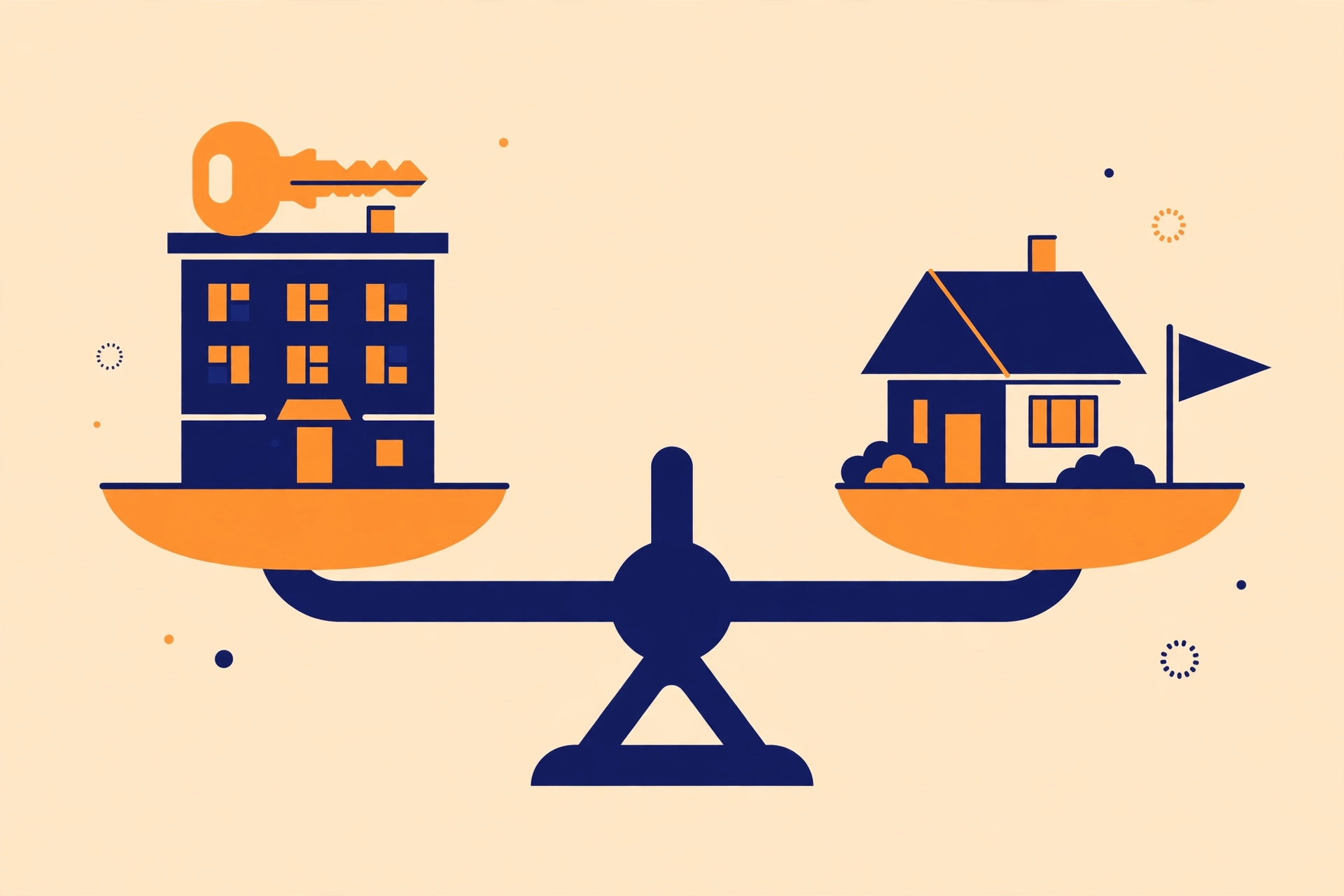
The core trade-off is simple. Renting buys flexibility and lower risk. Buying buys stability, control and the chance to build wealth over time. Everything else in this guide is a variation on that trade.
Upfront Costs Compared
The biggest difference between renting and buying is the cash you need before you move in. To rent, you usually need a security deposit, often equal to one or two months’ rent, plus the first month’s rent and perhaps an application fee. In many cities the total is a few thousand dollars.
To buy, you need a down payment and closing costs. A down payment typically runs from 3% to 20% of the home’s price, and closing costs add another 2% to 5%. On a $400,000 home, that means roughly $12,000 to $80,000 for the down payment alone, plus about $8,000 to $20,000 in closing costs, before you even get the keys. A buyer using a 20% down payment on the national median existing-home price of $417,500 would need $83,500 just for the deposit. That is the single biggest barrier to ownership, and it is why many people rent for years while they save. If you are saving toward that first deposit, our step-by-step guide to how to buy your first home explains the full process, and you can find more property guides in our Real estate section.
Monthly Costs Compared
Rent is usually straightforward: one monthly payment, plus renter’s insurance, utilities and sometimes parking or pet fees. The landlord handles repairs, and your housing cost is predictable for the length of the lease, although rent can rise at renewal.
Owning is more layered. Your monthly payment includes the mortgage principal and interest, property taxes, homeowners insurance, and possibly private mortgage insurance. On top of that come maintenance and repairs, which owners must budget for themselves, and HOA fees if the home is in a managed community. A fixed-rate mortgage locks in the principal and interest part of the payment, which gives long-term predictability, but taxes, insurance and repair costs can still climb.
In 2026, the monthly gap is wide. Realtor.com’s analysis found renting a starter home cheaper than buying one in all 50 of the largest US metros, by about $920 a month on average. The median asking rent was about $1,694 a month, while buying the median-priced home with 20% down at prevailing rates cost about $3,190 a month. Those are national figures and your local market will differ, but the direction is clear: in today’s market, renting is usually cheaper month to month.
The Pros and Cons of Renting
Renting has clear advantages. Upfront costs are low, which makes it accessible if you do not have a large savings cushion. Flexibility is high: if your job, relationship or city changes, you can move when the lease ends. Maintenance surprises belong to the landlord, so a broken boiler is a phone call, not a bill. In many markets in 2026, renting also means a lower monthly housing cost than buying a comparable home, which can leave more money to save or invest elsewhere.
The drawbacks are real too. Rent payments do not build equity or ownership, and they do not create an asset you can borrow against or sell. Rent can rise over time, which increases your long-term housing cost, and a landlord can decide not to renew your lease. You also have limited control: you generally cannot renovate, paint freely, or keep pets without permission, and you live with the landlord’s decisions about the property.
The Pros and Cons of Buying
Buying can build wealth. Each mortgage payment reduces the loan balance, building equity, and if home values rise, your equity grows further. That equity can later be tapped through a home equity loan or realised when you sell. A fixed-rate mortgage gives you predictable payments for decades, and ownership gives you stability and complete control: you can paint the walls, extend the kitchen, and stay as long as you like. In some countries, mortgage interest and property tax payments may also be tax-deductible, although the rules vary and have changed over time, so check your local tax law rather than assuming a benefit.
The costs and risks are just as real. Upfront costs run into tens of thousands of dollars. Monthly costs are usually higher than renting a comparable home in today’s market, especially with elevated interest rates. Maintenance, repairs, taxes and insurance are all your responsibility, and a single major repair can cost thousands. Home values can stagnate or fall, particularly over short ownership windows, so buying and selling within a few years can leave you worse off than renting. Buying too early, stretching too hard, or moving too soon can turn equity-building into a financial strain.
The Breakeven Point: How Long Until Buying Wins?
The breakeven point is the number of years after which the total cost of buying becomes lower than the total cost of renting the same home. It depends on the home price, the mortgage rate, how fast home values rise, how fast rent rises, and what you do with the money you save by renting.
In one 2026 example based on the median-priced home, buying overtook renting after about 15 years if home values rose 3% a year and the renter invested the money saved by renting. If the renter spent those savings instead, buying pulled ahead in about 4 years. That spread shows how much the answer depends on your behaviour, not just the market. The general rule of thumb is that you need to stay put for roughly five years or more before buying starts to make financial sense, because the upfront costs of buying and selling are so large that they swamp the monthly savings of ownership in the early years.
There are simple rent-versus-buy calculators online that let you put in your own numbers: the rent, the home price, the down payment, the interest rate, how long you will stay, and how fast you expect prices and rents to rise. Use one before you decide, because national averages hide huge local differences. A market where homes are cheap relative to rents can favour buying strongly, while a market where prices are high and rents are flat can favour renting for a decade.
Who Should Rent, and Who Should Buy?
Rent if you might move within three to five years. Rent if you do not have a solid emergency fund left over after closing, because homeownership without savings turns every repair into a crisis. Rent if your income is uncertain, if you are still deciding where to settle, or if you want the freedom to move for a job without the anchor of a house to sell. Renting is also sensible if you want to invest the difference between rent and a mortgage elsewhere, provided you actually invest it.
Buy if you plan to stay in one place for at least five years, and preferably longer. Buy if you can afford the full monthly cost of ownership, not just the mortgage, including taxes, insurance and maintenance, while keeping an emergency fund intact. Buy if you value stability, control over your home, and the long-term wealth-building that equity provides. And buy when the numbers in your local market support it: check the breakeven point for your own city and your own timeline, rather than relying on national averages.
Neither choice is a moral judgement. Renting is not failure and buying is not automatically success. The right answer is the one that matches your finances, your plans and your tolerance for risk. If you decide to buy, our guide to how to buy your first home walks you through the steps, and our Real estate category has more guides on valuing, selling and investing in property. There is also a useful overview of the subject on Wikipedia’s real estate page for background on how housing markets work.
Frequently Asked Questions
Is renting really throwing money away?
No. Rent buys you a place to live, flexibility and freedom from repair bills and property taxes. The money is not wasted: it pays for housing, just as a mortgage payment pays for housing plus interest, taxes and insurance. The better question is which option leaves you better off overall after several years, and that depends on how long you stay and what your local market looks like.
How long should I stay in a home for buying to be worth it?
As a rule of thumb, at least five years. Buying involves large upfront costs, including the down payment, closing costs and later selling costs, and it takes years of mortgage payments and possible price growth for those costs to pay off. If you may move within three years, renting is usually the safer financial choice.
Is it cheaper to rent or buy in 2026?
Month to month, renting is usually cheaper in 2026. Realtor.com found renting a starter home cheaper than buying in all 50 of the largest US metros, by about $920 a month on average. Over a long enough stay, buying can still come out ahead because of equity and the chance of price growth.
Does buying a home always build wealth?
Not always. Buying can build wealth through equity and appreciation, but buying too early, stretching too hard, or moving too soon can leave you worse off. Home values can fall, and the costs of buying, maintaining and selling a home are substantial. Wealth-building depends on buying at a price you can afford and staying long enough for the maths to work.
Can I buy a home with a low down payment?
Yes. Many first-time buyers qualify with 3% down on a conventional loan or 3.5% on an FHA loan, and eligible veterans and rural buyers may qualify with no down payment. A smaller down payment means a larger loan, higher monthly payments, and usually mortgage insurance, so weigh that against waiting and saving more.
The renting versus buying decision is personal, and it is allowed to change over time. Renting while you save, learn a city and stabilise your career is a sensible plan, not a delay. Buying when you are settled, funded and ready to stay is a different kind of sensible. Run your own numbers, be honest about how long you will stay, and choose the option that fits the life you actually have.
Related: Home Improvement