DIY Shelving Ideas for Every Room
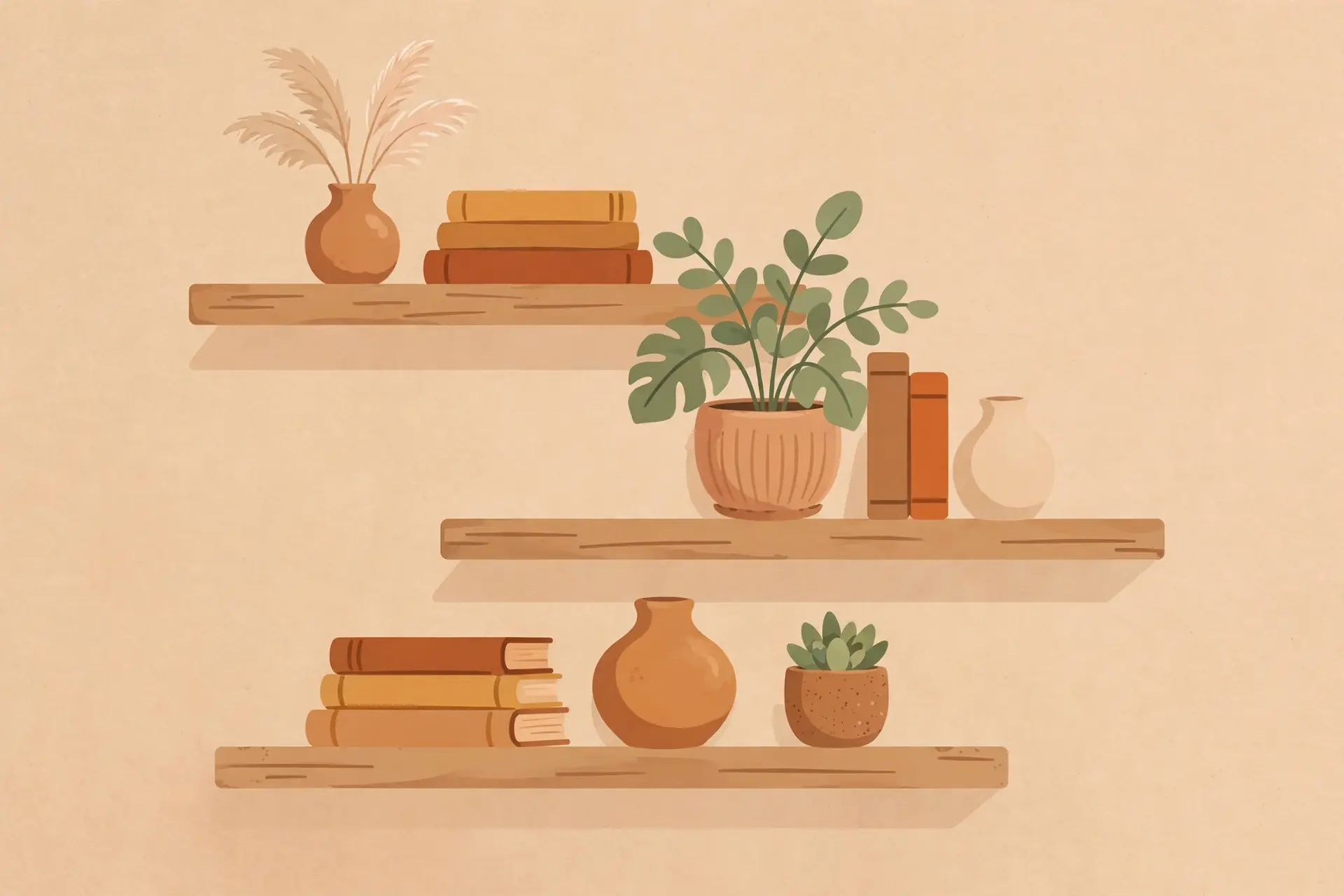
A well-placed shelf can change a room. It adds storage without taking up floor space, gives you somewhere to show off the things you love, and fills those awkward blank walls that every home seems to have. The best part is that shelving is one of the most beginner-friendly DIY projects there is: most designs need only a drill, a level, a stud finder and a few boards and brackets.
This guide gathers practical DIY shelving ideas for every room in the house — the living room, kitchen, bedroom, bathroom, home office and hallway — plus the installation basics that keep shelves level, sturdy and safe. Whether you are building floating shelves, bracket shelves, or a full bookcase wall, you will find a project here that fits your skill level and your budget. For more storage and decorating inspiration, explore our Home Improvement guides.
⚡ Quick Answer: DIY Shelving Ideas for Every Room
The best DIY shelving ideas start with the wall, not the shelf: find the studs first, because a shelf anchored into studs can hold 50 pounds or more per stud, while drywall alone will not hold a heavy load for long. Floating shelves suit bedrooms and living rooms, sturdy bracket shelves work best in kitchens and garages, and picture ledges are perfect for hallways and children’s rooms. A 10 to 12-inch depth suits most shelves without sagging, and two brackets per shelf is the minimum for anything wider than a couple of feet.
Contents
- Quick Answer: DIY Shelving Ideas for Every Room
- Before You Start: The Rules That Keep Shelves Up
- Floating Shelves: The Clean, Modern Classic
- Bracket Shelves: Strong, Simple and Stylish
- DIY Shelving Ideas for the Living Room
- DIY Shelving Ideas for the Kitchen
- DIY Shelving Ideas for the Bedroom
- Bathroom and Home Office Shelving
- Creative and Budget Shelving Ideas
- How to Style Shelves Like a Designer
- Frequently Asked Questions
Before You Start: The Rules That Keep Shelves Up
Every shelving project lives or dies on its fixings. A shelf full of books weighs far more than it looks, and plasterboard on its own will not hold it for long. Before you drill a single hole, find the studs with a stud finder, mark them, and plan your brackets so they hit solid timber wherever possible. When studs are not where you need them, use heavy-duty wall anchors rated for the weight you plan to carry, and never guess at the rating.
Measure twice and use a spirit level on every shelf — a shelf that is even slightly off-level is painfully obvious once books and vases are on it. Decide the depth before you buy: a depth of 10 to 12 inches suits most shelves without sagging in the middle, while longer spans need a third bracket in the centre. Sand every board smooth, and if you are painting or staining, finish the boards before you hang them; it is far easier to get a clean finish on a workbench than on a wall. For a refresher on the tools involved, our Home Improvement section covers the basics of DIY home projects.
Floating Shelves: The Clean, Modern Classic
A true floating shelf has no visible brackets — it looks like a flat surface sticking straight out of the wall. The secret is a hidden bracket: a steel plate with rods that fix to the wall, over which a hollow shelf slides. The bracket must be the same width and height as the shelf or slightly smaller, and the shelf either has holes drilled in it to match the rods or is hollow in the middle. This is how a shelf can appear to hover at 90 degrees to the wall.
Floating shelves suit living rooms, bedrooms and bathrooms, where they give a light, uncluttered look. They are surprisingly easy to install if you buy a kit with the bracket included, and cost as little as 20 pounds or dollars per shelf if you build your own from a wooden board and a pair of hidden rod brackets. The trickiest part is drilling deep, exact holes into both the wall and the shelf for the bracket rods, so take your time and measure carefully. A floating shelf is a type of shelf, a flat horizontal surface used to store or display items, and the floating version simply hides its support to create a cleaner look.
For heavy loads, floating shelves need to be fixed into studs — a shelf secured into a stud can hold around 50 pounds per stud — or use heavy-duty anchors. Lightweight items like plants, framed photos and small ornaments are safe on almost any fixing, but a row of hardback books needs proper support.
Bracket Shelves: Strong, Simple and Stylish
Bracket shelves are the workhorse of DIY shelving: a board resting on two or more brackets, with the brackets doing all the holding. Each shelf needs at least two brackets, and really wide or heavily loaded shelves need three or more. The style of bracket changes the whole look of the shelf. Slim black metal L-brackets give a clean, modern feel; chunky wooden brackets suit a cottage or farmhouse style; and black iron pipe fittings — a floor flange screwed to the wall with a short pipe nipple and a cap — create an industrial look that works beautifully in kitchens and home offices.
The simplest beginner build is a pine board, sanded and stained, on two metal brackets. It takes under half an hour, costs very little, and holds plenty of weight. For a more finished look, you can hide the brackets under the shelf and add a thin strip of wood to the front edge to make the shelf look thicker than it is. Paint the brackets the same colour as the wall if you want them to disappear, or choose a contrasting finish — brass, matte black or copper — if you want them to be a feature.
DIY Shelving Ideas for the Living Room
In the living room, shelves are as much about display as storage. A set of three floating shelves arranged in a staggered pattern above a sofa creates a gallery wall without the clutter of a full bookcase. Picture ledges — narrow shelves with a small lip at the front — are perfect for leaning framed art, prints and small canvases, and you can swap the pictures around whenever you like without making new holes in the wall.
If you have an alcove or a chimney breast, a wall-to-wall floating shelf turns it into a feature. The shelf is built as a hollow box that slides over a hidden timber cleat screwed into the studs, which makes it strong enough for books and ceramics. For a bigger statement, build a floating bookcase: four or five bracket shelves stacked vertically with the spacing set to fit your books, from paperbacks to tall art books. Set the lowest shelf about 30 inches from the floor to keep the space underneath open and the room feeling light. For more ideas on rooms that get used every day, browse our Lifestyle articles.
DIY Shelving Ideas for the Kitchen
Open shelving has become one of the most popular kitchen upgrades because it makes a small kitchen feel brighter and more open. Replacing one run of upper cabinets with live-edge or chunky wooden floating shelves gives you easy access to everyday dishes, mugs and plants, and costs far less than new cabinetry. Keep the shelves within arm’s reach of the worktop, and put only the things you actually use on them — open shelves work best when they hold a curated set of items rather than everything you own.
A plate rack shelf with a groove cut into the underside is a classic kitchen design: plates stand upright in the groove, and cups hang from hooks underneath. A narrow spice shelf on the inside of a pantry door or on a bare stretch of wall near the cooker keeps jars visible and easy to grab. For heavy items like cast-iron pans and stacks of plates, use solid bracket shelves fixed into studs, not floating shelves — the weight adds up fast. Whatever you choose, keep the depth at 10 to 12 inches so shelves do not crowd the worktop below.
DIY Shelving Ideas for the Bedroom
Bedrooms benefit most from shelves that save floor space. A floating bookcase beside the bed is a perfect example: it stores books, a lamp and a phone charger without needing a bulky bedside table, which is a lifesaver in a small bedroom or a child’s room. Space the shelves about 16 inches apart to fit books of different heights, and keep the lowest shelf high enough that nothing gets kicked.
A single long shelf above the headboard acts as a display ledge for art, photos and a small plant, and a pair of cubby shelves in the corner turns dead space into shoe or accessory storage. In a child’s room, a wooden pallet bookshelf with the slats facing out holds picture books face-forward so little readers can spot their favourites. For teenagers, old skateboard decks mounted on simple shelf brackets make fun, personal shelves that cost almost nothing.
Bathroom and Home Office Shelving
Bathrooms are full of small items that need a home, and small shelves are the answer. A couple of narrow floating shelves above the toilet or beside the mirror hold rolled towels, jars and toiletries without taking up floor space. In a damp room, choose moisture-resistant materials: sealed wood, glass, or powder-coated metal brackets, and leave a gap between the shelf and the wall so air can circulate behind it.
In a home office, shelves keep the desk clear and the workday organised. A wall of bracket shelves above the desk holds reference books, files and a printer, while a picture ledge is perfect for pinning up inspiration and notes. Industrial pipe and wood shelving fits a home office particularly well: black iron pipe frames with wooden boards give you a sturdy, adjustable system that looks intentional rather than improvised. A shelf with a built-in cable hole keeps chargers and cords tidy.
Creative and Budget Shelving Ideas
Some of the best shelving ideas cost almost nothing. Wooden crates from a thrift store, screwed to the wall in a grid, make charming display cubbies for a playroom or hallway. Leather strap hanging shelves — a board suspended from two leather straps screwed into the wall — add warmth and texture to a bedroom or reading nook and need no brackets at all. Honeycomb or hexagonal shelves, built from six short boards joined at angles, turn a plain wall into a piece of geometric art.
Reclaimed wood is another great source. Old floorboards, scaffolding planks or barn wood, cleaned and sanded, make shelves with character that new timber cannot match. A rope swing shelf — a board hung from two lengths of rope — suits a nursery or a bohemian living room, but keep it for light items only. Triangle corner shelves fill the dead space where two walls meet, which is ideal for a small plant or a stack of books in a bathroom or hallway.
How to Style Shelves Like a Designer
Hanging the shelf is only half the job; styling it is what makes it look good. The rule designers use is to mix heights, textures and shapes: a tall vase next to a stack of books, a small plant next to a framed photo, a ceramic bowl next to a candle. Leave some breathing room — a shelf crammed edge to edge looks cluttered, while a shelf with a few gaps looks deliberate. Group items in odd numbers, usually threes, which the eye finds more pleasing than even pairs.
Keep heavy and dark items low and light items high, and repeat a colour or material two or three times across the shelves to tie them together. In a kitchen, stack white plates and bowls with a wooden chopping board for warmth; in a living room, mix books with a trailing plant and a framed print. And do not forget the practical side: put the things you use every day at arm’s height and the display-only pieces higher up.
Frequently Asked Questions
How much weight can a DIY floating shelf hold?
A floating shelf fixed into wall studs can hold around 50 pounds per stud, which is plenty for books and ceramics. A shelf held only by drywall anchors holds much less — typically 15 to 30 pounds — so always check the anchor rating and keep heavy items on stud-fixed shelves.
What is the best depth for floating shelves?
A depth of 10 to 12 inches suits most shelves without sagging. Deeper shelves need extra brackets or a thicker board, and shelves deeper than 14 inches start to look bulky and crowd the room.
Do I need to find studs to hang a shelf?
For anything heavy, yes. Studs are the only fixing that reliably holds a loaded shelf long term. For very light items, heavy-duty wall anchors are an acceptable alternative, but a shelf full of books should always be anchored into studs.
What is the easiest DIY shelving project for a beginner?
A single board on two metal L-brackets is the easiest start: measure, find the studs, level the brackets, and screw the board down. It takes under an hour, costs very little, and teaches you every skill you need for bigger projects.
Can I put shelving in a rented home?
Yes, with renter-friendly options like peel-and-stick ledge shelves, tension-rod shelves, or freestanding ladder shelves that lean against the wall without any drilling. Always check your tenancy agreement before drilling holes, and use removable fixings where the rules require it.
If you want a deeper understanding of the furniture and fittings involved, the Wikipedia article on bookcases covers the history of shelving furniture and the many forms it has taken.