
Work-Life Balance Tips That Actually Work
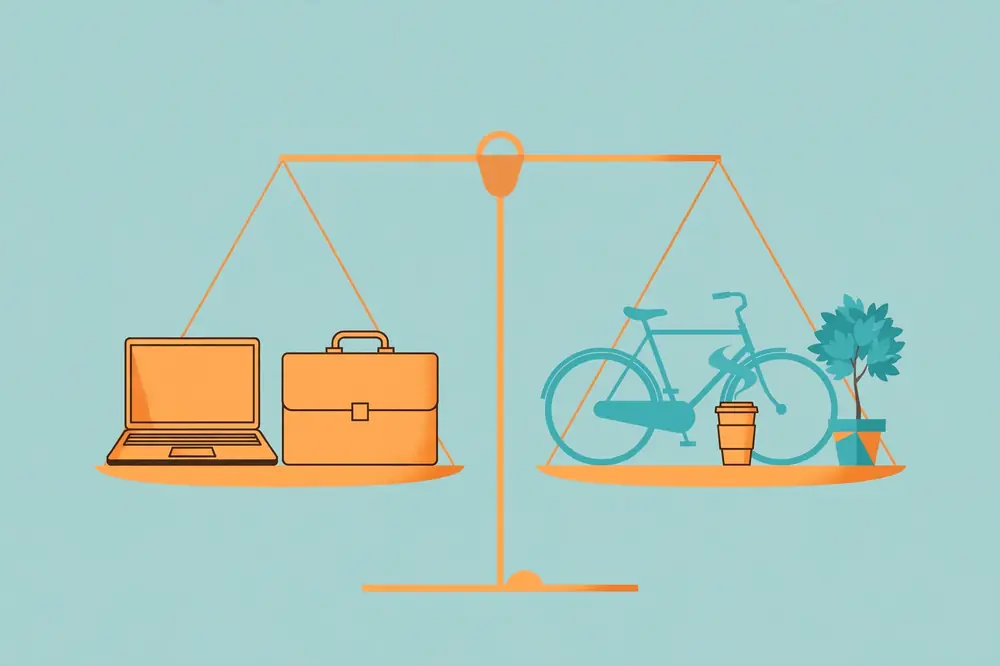
Work-life balance is one of those phrases everyone agrees with and almost nobody achieves. The reason is not laziness. It is that the line between work and life has quietly disappeared. Email follows you home, chats ping at dinner, and the laptop on the kitchen table means you are never quite at work and never quite off it either. The result is not more work done, it is less rest, less focus, and a slow slide toward exhaustion that feels normal because everyone around you is sliding too.
The good news is that work-life balance is not a personality trait. It is a set of practical habits, and the ones that work are far more ordinary than the advice usually suggests. No grand reinvention is required. What follows are work-life balance tips that actually work, drawn from what researchers and workplace psychologists report, not from inspirational posters.
⚡ Quick Answer: What Are the Best Work-Life Balance Tips?
The best work-life balance tips are to set a fixed end to your working day, turn off work notifications after hours, protect one or two evenings a week for rest, take regular short breaks, and treat recovery as part of the work, not a reward for finishing it. Research on burnout shows that people who set clear boundaries report far less burnout than those who do not. The single most effective change is usually a hard finish time, kept seven days a week, because it forces everything else to fit inside the day.
In This Article
- Quick Answer: What Are the Best Work-Life Balance Tips?
- What Work-Life Balance Actually Means
- Why Boundaries Matter More Than Hours
- Tip 1: Set a Finish Time and Keep It
- Tip 2: Build a Daily Shutdown Ritual
- Tip 3: Manage Energy, Not Just Time
- Tip 4: Learn to Say No Without Guilt
- Tip 5: Buy Recovery in Bulk
- Work-Life Balance When You Work From Home
- Signs Your Balance Is Slipping
- Frequently Asked Questions
What Work-Life Balance Actually Means
Work-life balance means dividing your time and energy between work and personal life in a way that prevents burnout, reduces stress, and protects your health and happiness. The important word is balance, not equality. Some weeks genuinely demand more work, such as a product launch or an exam season, and some weeks allow more rest. Balance is about the pattern over months, not about any single day being perfectly split.
It is also not about doing everything. A common misunderstanding is that balance means a full career, a perfect home, a busy social life and daily exercise, all at once. True balance, as several researchers put it, is about doing what matters and doing it well, which means choosing. The person who works late three nights a week but protects the other four evenings has better balance than the person who works “just a little” every single evening, because the second person never actually rests.
One more thing worth saying plainly. Balance is a shared responsibility, not purely a personal one. A manager who sends emails at midnight and a workplace that rewards presenteeism make balance harder than any amount of personal discipline can fix. The tips in this article are things you can control. If your workplace makes them impossible, that is a conversation worth having, not a failure of your time management.
Why Boundaries Matter More Than Hours
The most striking evidence about boundaries comes from a study of 308 entrepreneurs around the world, carried out by researchers at Lehigh University with the Nasdaq Entrepreneurial Center and TU Dortmund. They found that founders who did not set boundaries were almost three times as likely to report high burnout: 67 percent, against 23 percent for those who did set boundaries. The boundary-setters did not work less or care less about growth. They simply had a line, and they kept it.
That finding matches what the World Health Organization says about occupational burnout, which it describes as a phenomenon characterised by feelings of energy depletion, increased mental distance from one’s job, and reduced professional effectiveness. Burnout is not simply feeling tired after a long week. It is what happens when the depletion never gets a chance to reverse, and the main reason it never reverses is that the work never actually stops.
There is also a productivity argument, for those who need one. A Stanford University study, often cited in discussions of working hours, found that productivity drops significantly after about 50 hours of work a week and falls sharply beyond 55 hours. Long weeks are not just bad for your health, they are bad for the work itself. Work-life balance tips that protect your rest are not indulgences. They are how you stay good at your job over years rather than months.
Tip 1: Set a Finish Time and Keep It
Choose a time when work ends, write it down, and treat it like a meeting you cannot move. Eight o’clock, six o’clock, five-thirty, whatever fits your life, but one fixed time you defend. Turn off your work email and chat notifications at that time, or better, log out of them. Put the laptop away, not just closed. A closed laptop on the table is still visible, and visible work is work you will drift back to.
A fixed finish time has a useful side effect. When the end of the day is real, the middle of the day gets more efficient, because the work has to fit inside it. People who work without an end time tend to let tasks spread, check email constantly, and spend the evening half-working. People with a hard finish tend to prioritise, because the deadline is daily and non-negotiable. Tell your colleagues your hours, and schedule your own emails to send during office hours, especially if you are a manager. Your team will take their cue from you, so a late-night email from a boss is a signal that rest is not really allowed.
Tip 2: Build a Daily Shutdown Ritual
A shutdown ritual is a short sequence you perform at the end of every working day, and it works for the same reason a bedtime routine works: repetition trains your brain. A good ritual takes five minutes and has three parts. First, write a to-do list for tomorrow, so the unfinished tasks leave your head and sit on paper. Second, write a short done list of what you completed today, which gives your brain the satisfaction of closure and makes the day feel finite. Third, tidy your desk and close your work apps, so tomorrow starts clean.
Researchers at the University of Georgia, writing about recovery from work, make a similar point: the mind needs a clear signal that work is over, or it keeps rehearsing it all evening. A written list is that signal. It is also worth keeping your work phone and your personal phone separate where possible, or at least keeping work apps in a folder you can close. The easier it is to drift back into work, the more often you will.
Tip 3: Manage Energy, Not Just Time
Time management advice usually assumes that all hours are equal. They are not. Most people have two or three genuinely sharp hours a day and a long tail of tired ones. Work-life balance tips that ignore this waste everyone’s effort. Do your hardest task while you are fresh, and leave emails and routine jobs for later in the day, when your energy is lower. This is one of the simplest changes in the whole article, and one of the most effective.
Take real breaks too. Microbreaks every 60 to 90 minutes improve mental energy and reduce the aches that come from sitting too long. A five-minute walk outside, ideally in daylight, helps more than five more minutes at the desk. Studies reported by Stanford suggest even a short walk outdoors can improve creative thinking and lower anxiety. Lunch is not an optional extra either. Eat away from your desk when you can, and take the full break if your workplace allows it. Working through lunch every day is not a badge of dedication, it is a fast route to an afternoon where nothing gets done properly.
Sleep is the foundation under all of this. Seven to nine hours of sleep regulates the stress hormones that make every work problem feel bigger than it is. If you are regularly sleeping badly because of work pressure, the fix is partly in your sleep habits. Our guide to a healthy sleep routine covers that side of the equation in detail.
Tip 4: Learn to Say No Without Guilt
Overcommitting is one of the major causes of burnout, and it is also one of the hardest habits to change, because saying yes feels helpful and saying no feels selfish. It is not. Every yes to a low-priority task is a no to something that matters more, usually rest, family, or the work you are actually good at.
Use a delaying phrase instead of an instant answer. “Let me check my schedule first” gives you space to decide properly, and most requests survive a few hours of waiting. If you do say no, be brief and clear. “I can’t take that on this week” is enough. Long explanations invite negotiation. You do not need a reason that convinces the other person. You need a boundary that protects your time.
The same principle applies at home. Balance is not only about work spilling into life, it is also about life having no protected space of its own. Put family time, exercise, or an evening class on the calendar before the working week fills it, and defend those entries like work meetings. A commitment that is written down is far more likely to survive than one that exists only as a vague intention.
Tip 5: Buy Recovery in Bulk
Recovery works better in large blocks than in small ones. That sounds backwards, but research on rest from work, including a study by Ryan Grant at the University of North Carolina at Charlotte, suggests that bigger periods of rest provide more benefit to well-being than the same total time split into tiny fragments. Grant calls it the “Costco study” idea: buy your recovery in bulk.
In practical terms this means: take your holiday days, all of them, and take at least some of them as a proper block rather than a string of single days off. Protect one evening a week that is completely work-free, not just less work. Take a full weekend where possible, and do not fill it with chores that feel like a second job. A weekend spent entirely on errands is not a weekend off. The people who recover best are not the ones who rest the most hours in total, they are the ones whose rest is uninterrupted enough to actually work.
Work-Life Balance When You Work From Home
Remote work removes the commute, which should help balance, but it also removes the boundary the commute used to provide. Without it, many people work longer and feel worse, because the office is always one room away. The fixes are physical and procedural.
Set up a distinct workspace, even if it is only one end of a table, and leave it at the end of the day. Get dressed for work rather than working in sleep clothes, which blurs another boundary. Take a fake commute: a ten-minute walk before work and another after it, which gives your brain the transition the train used to provide. Keep your working hours visible to the people you live with, and agree on when you are interruptible and when you are not. And if your home has become a place where you can never quite relax, simple changes to the space itself can help. Our Lifestyle section has more on creating a calmer home, and our Health section covers the rest and movement side of balance.
Signs Your Balance Is Slipping
Balance rarely collapses in a day. It erodes quietly, and the early signs are easy to miss. Watch for these: you check work messages the moment you wake and last thing before sleep; you cancel plans with friends or family regularly because of work; you feel guilty when you rest, as if resting is something that must be earned; you are tired even after a full night’s sleep; and small problems at work feel enormous. Any one of these on its own is not a crisis. Three or more, sustained for weeks, means the balance has already tipped, and the remedy is not a better to-do list, it is protected time away from work.
If you recognise yourself in that list, start with the smallest possible change. Pick one evening this week, and make it genuinely work-free. No email, no “quick check”, no laptop on the table. Notice how hard that feels. The hardness is information, not failure. It tells you how deep the habit has gone, and it tells you that the boundary, once built, will be worth keeping. And if the pressure is coming mainly from your manager or your workplace culture, raise it as a health issue rather than a preference, because that is what it is, and a good employer will take it seriously.
Work-life balance is not about working less for the sake of it. It is about working well for longer, and about having a life that is worth coming home to at the end of the day. A fixed finish time, a daily shutdown, energy-aware scheduling, the ability to say no, and real blocks of rest: these five habits are ordinary, unglamorous, and they work. Pick one this week and defend it. The rest will follow.
Frequently Asked Questions
What is the best way to achieve work-life balance?
Start with a fixed finish time for your working day and stick to it, because that one boundary forces everything else into shape. Add a short daily shutdown ritual, take real breaks, and protect proper blocks of rest, including your full holiday allowance. Balance comes from boundaries, not from better time management alone.
How many hours a week should I work for a good balance?
There is no single number, since roles differ, but research suggests productivity falls significantly after about 50 hours a week and drops sharply beyond 55. If you regularly work more than that, something is wrong with the workload, not with you, and it is worth raising with your manager.
Can I have work-life balance in a demanding job?
Yes, but it takes deliberate boundaries. People in demanding jobs who set clear boundaries report far less burnout than those who do not. A fixed finish time, a shutdown ritual, and protected rest days work even in intense roles. If your workplace punishes boundaries, that is a management problem, and it may be worth a conversation or, in the longer term, a change.
How do I stop thinking about work at home?
Use a written shutdown ritual: list tomorrow’s tasks and today’s completed work, then close your work apps and put the laptop away. Physical distance helps, so keep work devices out of the bedroom. A short walk or some exercise straight after work also helps the brain switch modes, as does a genuinely absorbing evening activity.
Is working from home better for work-life balance?
It can be, but only with deliberate boundaries, because remote work removes the commute that used to separate work and home. A distinct workspace, fixed hours, a fake commute walk, and clear rules about when you are interruptible are the habits that make working from home help balance rather than harm it.